

El Tiempo
Elim Johana Alonso Dorado
PERIODISTA 09.07.2025 | Actualizado: 09.07.2025
A new report by the international organization Earth Insight argues that Colombia has an opportunity to prevent the expansion of extractive activities across more than 65 million hectares of its territory—an area equivalent to 54% of the country's total oil and gas blocks that have not yet been awarded. This area includes zones of ecological, cultural, and climatic value, such as the Amazon, the Pacific coast, indigenous territories, peasant reserves, Afro-descendant communities, intact tropical forests, and legally protected areas.
(In addition: Lower coal and oil sales continue to drag down Colombia's exports: in May, they fell by 2.1%).
Juan Pablo Osornio, director of outreach at Earth Insight, a US-based organization dedicated to developing spatial analysis tools for industrial expansion in areas of high biodiversity, explained the most relevant points of the report to EL TIEMPO.
Risk map: threatened communities and ecosystems
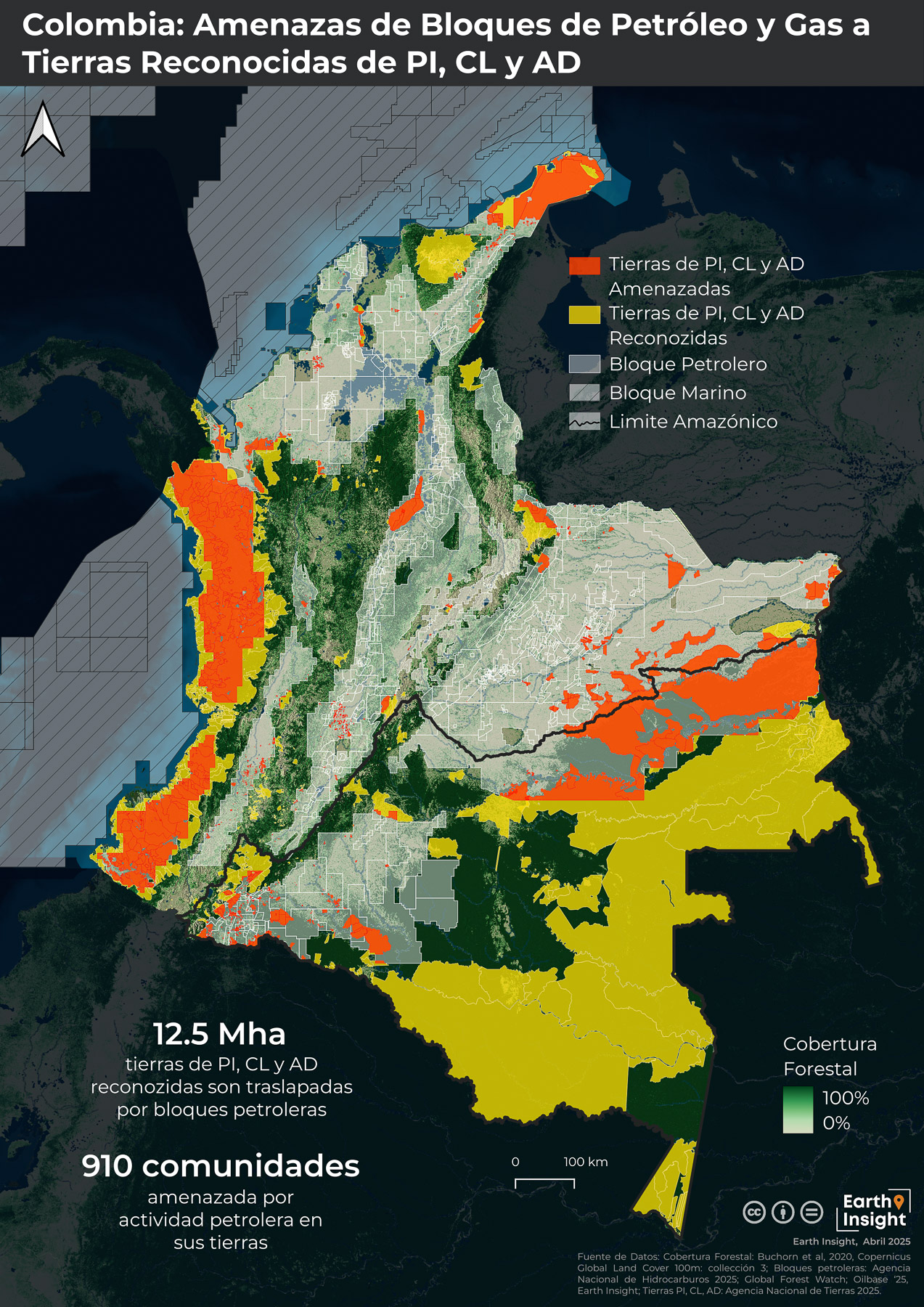
Oil and gas blocks in Colombia are areas delimited by the National Hydrocarbons Agency (ANH), which can be in different phases: production, exploration, suspended, or available for allocation. According to the report, around 12.5 million hectares of collective lands—legally recognized as Indigenous Peoples (IP), Local Communities (LC), and Development Areas (DA)—overlap with oil and gas blocks in any of these states.
These lands belong to Indigenous Peoples, Afro-descendant communities, and established peasant reserve areas.
According to Earth Insight's spatial analysis, 74% of all Indigenous reserves, community councils, and peasant reserve areas in the country (910 in total) are located within oil blocks, indicating that the risk is mostly future and avoidable.
“Less than one million hectares are currently under production or exploration blocks. The threat to these communities is largely future: 11.5 million hectares—about 28% of all their collective lands—are in blocks that are still available but could be concessioned in the future,” explains Osornio.
(Be sure to read: How much Colombia is managing to replace the gap in oil and coal exports with sales of other goods.