

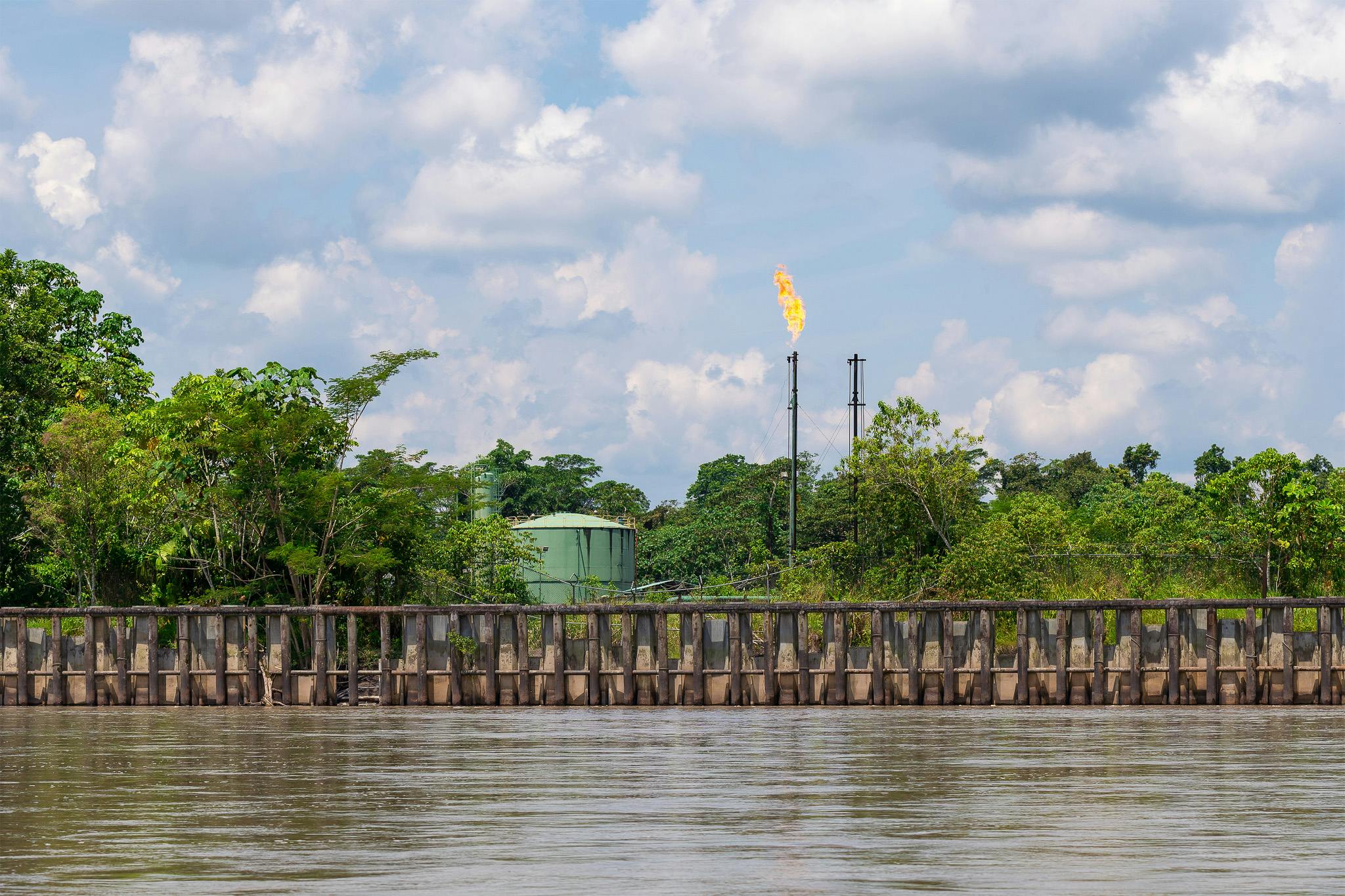
FOSPA: A Regional Gathering at a Critical Moment for the Amazon
The Pan-Amazonian Social Forum (FOSPA) is a biennial platform that brings together social movements, Indigenous Peoples, Afro-descendant Peoples, local communities, civil society, and academics from the nine Amazonian countries to advance collective action on Indigenous Peoples' rights, territorial governance, environmental justice, and alternatives to extractive development.
The XII FOSPA (2026) will be held from 16–21 August in Puyo and Yasuní, Ecuador. The choice of Yasuní is more than symbolic. It places regional discussions on Indigenous Peoples' rights, biodiversity conservation, and extractive industries in one of the Amazon's most emblematic landscapes, where landmark Indigenous victories are undermined by longstanding pressures from oil extraction.
The Amazon Basin: A Global Ecosystem at a Crossroads
The Amazon Basin is the world's largest tropical rainforest, covering approximately 670 million hectares across nine countries and encompassing the planet's largest river basin. It generates atmospheric rivers that transport an estimated 20 billion tons of water daily, regulating rainfall across South America and helping stabilize the global climate. The basin is home to hundreds of Indigenous Peoples whose cultures, governance and knowledge systems have sustained these forests for millennia.
Scientists warn that large portions of the Amazon Basin are approaching ecological tipping points as deforestation, forest degradation, climate change, infrastructure expansion, and extractive industries weaken the forest's resilience. Oil and gas development, mining, industrial logging, and associated infrastructure continue to fragment intact forests, pollute rivers, and threaten biodiversity and Indigenous Peoples' territories.
Approximately 30% of the Amazon (250 million hectares) comprises Indigenous Peoples' and local communities' lands, which play a critical role in maintaining forest integrity and preventing deforestation. Yet these territories face increasing pressure. Earth Insight's spatial analysis indicates that 31 million hectares of IPs and LCs lands are overlapped by oil and gas blocks, 9.8 million hectares are overlapped by mining concessions, and 2.4 million hectares are overlapped by industrial logging concessions. Reflecting the urgency of preventing Amazon tipping points, the International Union for Conservation of Nature (IUCN) adopted Resolution 129 (2020), followed by Resolution 068 (2025), calling for the protection and restoration of at least 80% of the Amazon's ecological integrity in partnership with Indigenous Peoples.
.png)
Yasuní and the Waorani: Global Victories Amid Continuing Threats
Few places better illustrate both the importance of the Amazon Basin and the challenges of conserving it than Yasuní National Park and the ancestral territory of the Waorani Nation. Yasuní is one of the world's most biodiverse places and home to the Waorani as well as the Tagaeri and Taromenane, Indigenous Peoples living in voluntary isolation. At the same time, it has long been one of Ecuador's principal oil-producing regions.
Recent years have brought landmark victories. In 2023, Ecuadorians voted to end oil extraction in Block 43 (ITT) through a historic national referendum. In 2025, the Inter-American Court of Human Rights ruled in Tagaeri and Taromenane Peoples in Voluntary Isolation v. Ecuador, finding that the State had violated multiple rights by permitting oil activities within and around Yasuní. Earlier, in 2019, the Waorani secured a landmark judgment overturning the government's consultation process for oil development in their territory, reinforcing the right to free, prior, and informed consultation.
These achievements demonstrate what is possible when Indigenous Peoples' leadership, public participation, and the rule of law converge. However, implementation has been slow. Only about 4% of the oil wells covered by the Yasuní referendum have been closed, while new government initiatives continue to promote oil development and legislative reforms have raised concerns about weakening Indigenous Peoples' territorial protections.
The impacts of decades of extraction remain evident. More than 3,500 contaminated sites have been documented in Ecuador's oil-producing regions, with only about half undergoing ecological restoration. Community monitoring by the Waorani Nationality of Ecuador (NAWE) found that 50% of surveyed Waorani reported impacts from oil pollution, including declining fisheries, reduced agricultural productivity, and loss of forest resources. Between July 2024 and March 2025, Waorani monitors documented 30 oil spills.
Legal Waorani territory covers approximately 800,000 hectares, 64% of which is overlapped by oil blocks, illustrating the continued pressure on Indigenous Peoples' territories despite important legal protections.
%20(1).png)
Ecuador's Expanding Extractive Frontier
The challenges confronting Yasuní are not simply the legacy of past oil development but part of a broader expansion of extractive activities across Ecuador's Amazon.
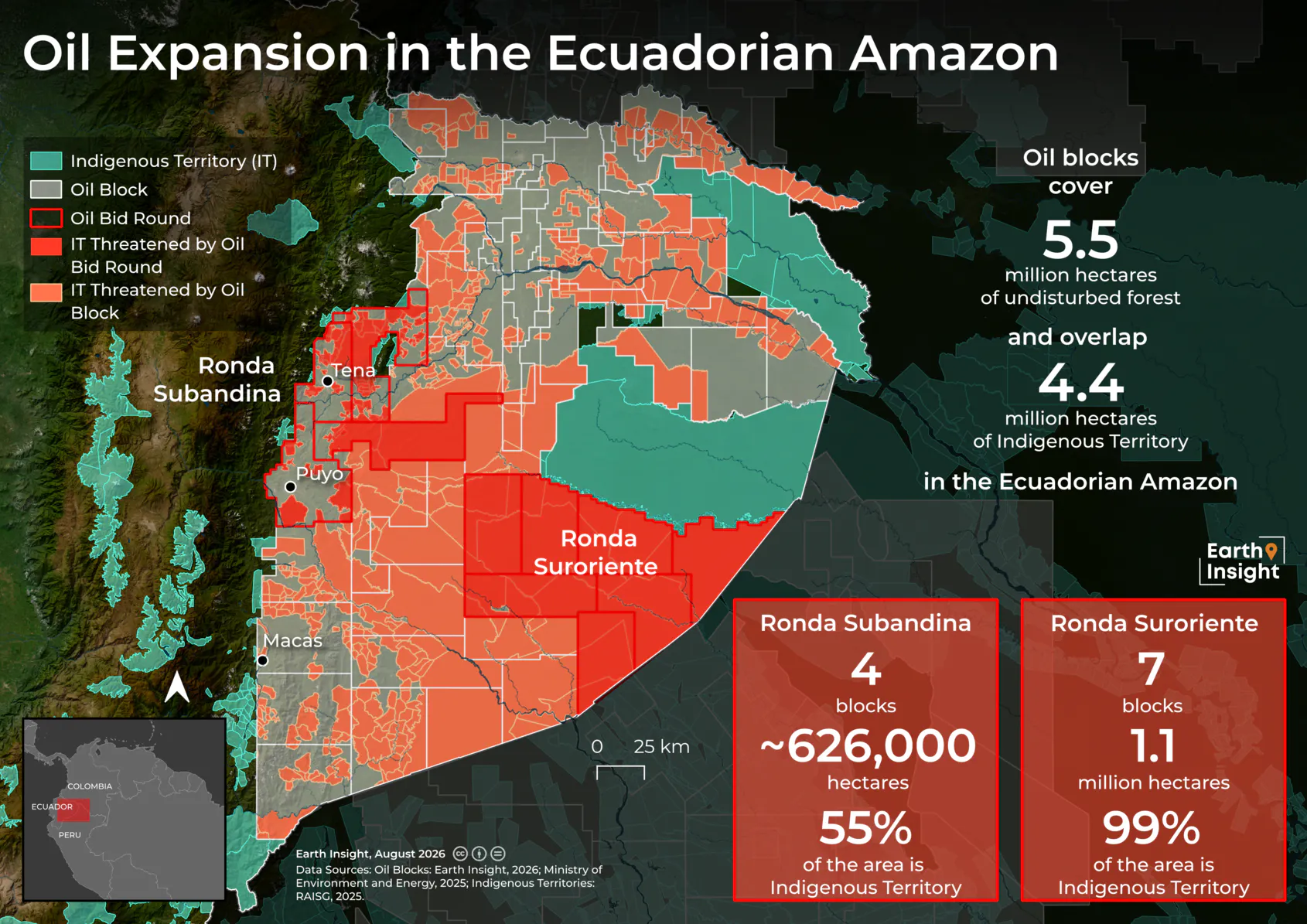
Earth Insight's new spatial analysis shows that oil blocks in the Ecuadorian Amazon cover approximately 5.5 million hectares of intact forest, including 4.4 million hectares within Indigenous Peoples' territories. The proposed Ronda Subandina covers approximately 626,000 hectares, 55% of which overlaps Indigenous Peoples' territories, while the Ronda Suroriente covers about 1.1 million hectares, 99% within Indigenous Peoples' territories.
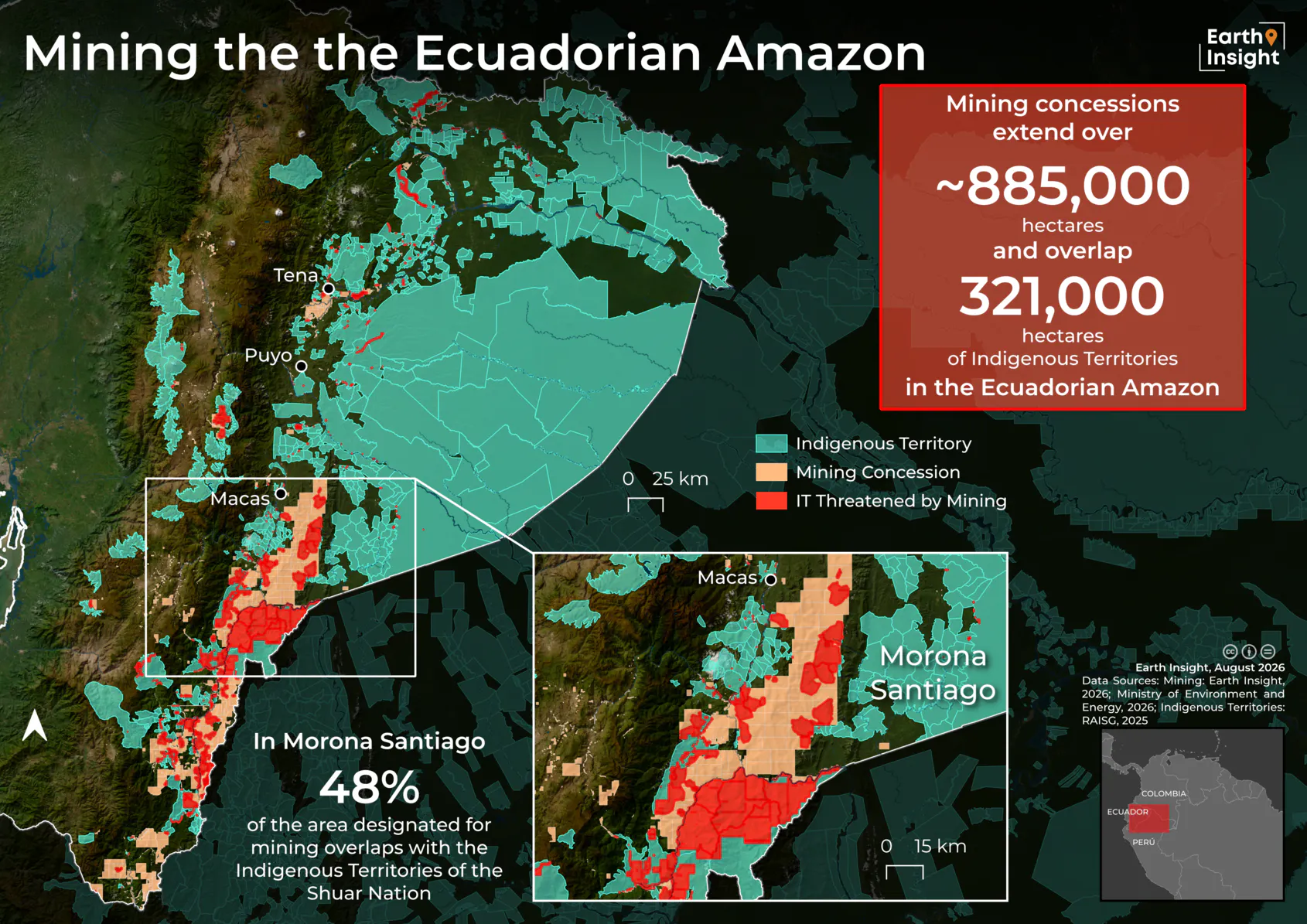
Mining presents a parallel challenge. Existing concessions and concessions under review extend across approximately 885,000 hectares of the Ecuadorian Amazon and overlap 312,000 hectares of Indigenous Peoples' territories. In the province of Morona Santiago, nearly 48% of concessioned land for mining falls within territories of the Shuar Nation.
Together, these figures demonstrate that extractive frontiers continue to expand into some of Ecuador's most ecologically intact and culturally significant landscapes and disproportionately impact Indigenous communities.
A Cautionary Tale for the Amazon Basin
Ecuador offers a compelling example of both the opportunities and challenges of advancing conservation, Indigenous Peoples' rights, and sustainable development in the Amazon Basin. It has produced some of the world's most significant victories for Indigenous Peoples' rights and biodiversity conservation, yet those gains remain vulnerable as implementation remains slow and extractive frontiers continue to expand. Many of the challenges evident in Ecuador, including overlapping extractive concessions, implementation gaps, and increasing pressure on Indigenous Peoples' territories, are shared across the Amazon Basin, reinforcing the importance of regional dialogue and collective action through FOSPA.
As participants gather in Puyo and Yasuní, they do so at the center of one of the Amazon's defining struggles. The Waorani experience demonstrates that safeguarding the Amazon Basin requires more than landmark court decisions or political commitments. It requires the effective implementation of Indigenous Peoples' rights and preventing new oil, gas, and mining expansion into intact forests and Indigenous Peoples' territories. In this sense, Yasuní is not only Ecuador's story, but it is also a cautionary tale for the entire Amazon Basin.
Sources:
- Earth Insight. (2026). FOSPA: A Regional Gathering at a Critical Moment for the Amazon. https://earth-insight.org/insight/fospa-2026/
- Foro Social Panamazónico Ecuador. (2026). XII Foro Social Panamazónico Ecuador. https://fospaecuador.com/
- Global Alliance of Territorial Communities (GATC) and Earth Insight. (2025). Indigenous Territories and Local Communities on the Frontlines. https://earth-insight.org/report/iplc-threats/
- International Union for Conservation of Nature (IUCN). (2021). WCC-2020-Res-129: Avoiding the point of no return in the Amazon: Protecting 80% by 2025. IUCN World Conservation Congress. https://portals.iucn.org/library/sites/library/files/resrecfiles/WCC_2020_RES_129_EN.pdf
- International Union for Conservation of Nature (IUCN). (2025). Motion 068 (Version 2): Emergency action to restore 80% of ecological integrity in Amazonia by 2030 preventing cascading tipping points. IUCN World Conservation Congress. https://iucn-2025.s3.eu-west-3.amazonaws.com/motions/en/068-V002-Emergency%20action%20to%20restore%20ecological%20integrity%20in%20Amazonia-EN.pdf
Baixe os mapas em português Descarga los mapas en español Download the maps in English