

The Global Call for Fossil Free Zones
Groups Call for Fossil Free Zones Ahead of the landmark International Conference on Energy Transition in Santa Marta, Colombia
Fossil Free Zones (FFZs) are geographically defined areas characterised by ecological, biodiversity, or cultural significance where fossil fuel exploration, extraction, and/or related infrastructure development are permanently prohibited. They translate the global commitment to "transition away from fossil fuels" into specific, enforceable, place-based decisions that governments can adopt at the national or subnational level. They are also an effective tool to comply with their legal obligations on climate action, as recently recognised by the Inter-American Court of Human Rights and the International Court of Justice.
FFZs build on existing frameworks for protected areas and Indigenous land tenure — tools already well understood by policymakers. Crucially, preventing new concessions in sensitive areas (i.e., not yet licensed) can serve as a first step without requiring a substantial legal overhaul.
Tropical Forests at Risk:
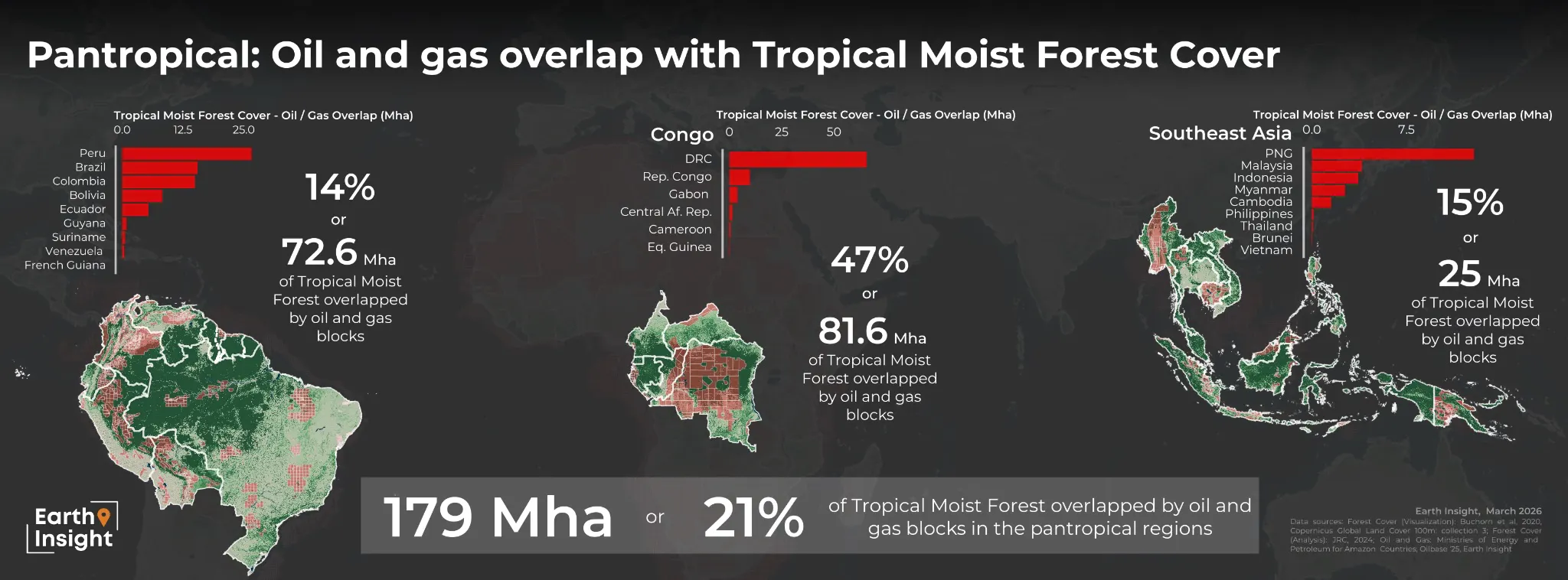
The urgency is significant. According to Earth Insight's new analysis, oil and gas blocks at various stages of development and production overlap with 179 million hectares of tropical moist forests — roughly 21% of high-integrity tropical forests across countries in the Amazon, Congo Basin, and Southeast Asia - often overlapping with Indigenous Peoples’ and Local Communities’ territories.
The breakdown by region:
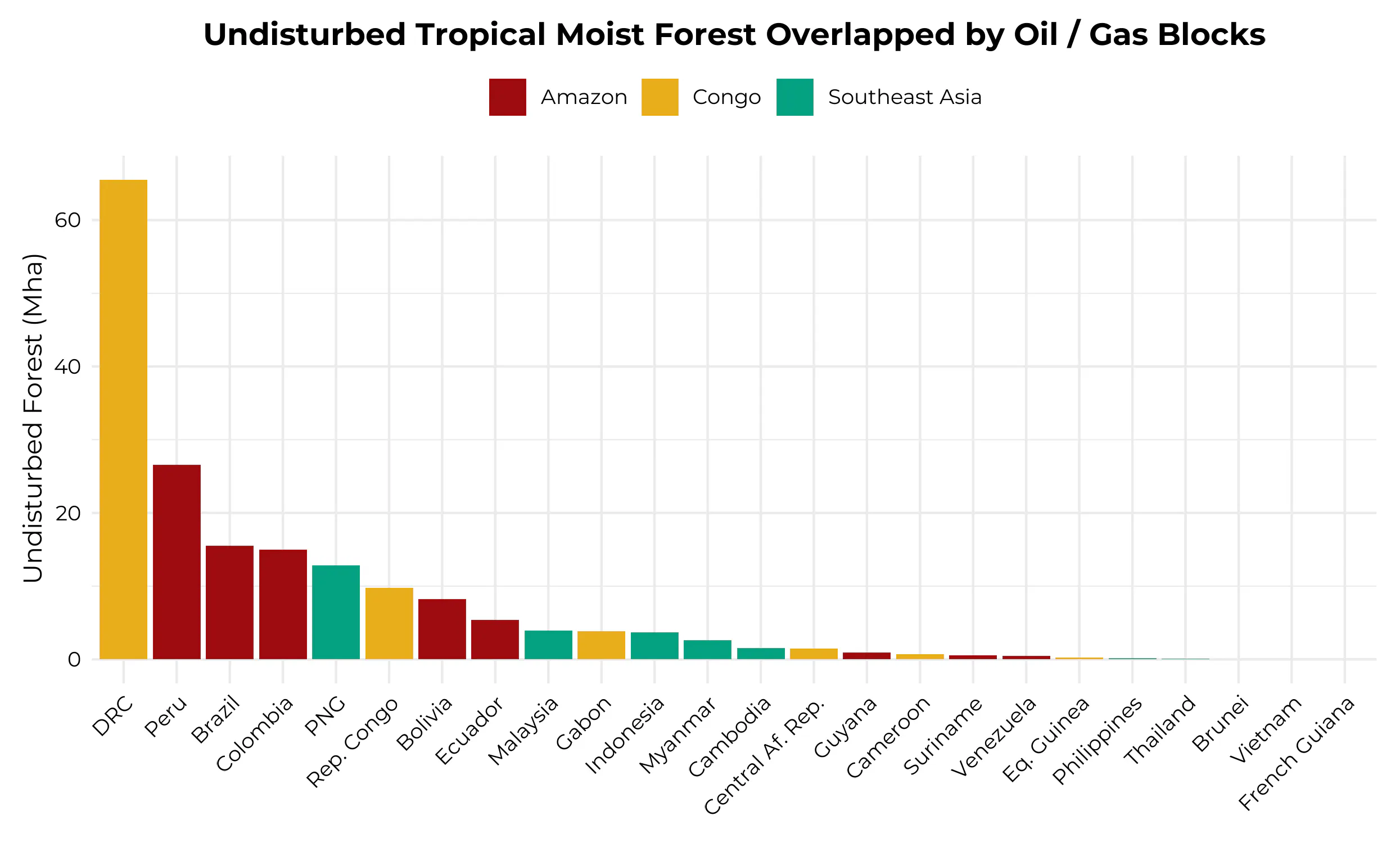
Amazon: 72.6 million hectares of forest cover, or 14% of tropical moist forests. Oil and gas threats to forests are highest in the western Amazon — Peru (40%), Bolivia (41%), and Ecuador (47%).
Congo Basin: 81.6 million hectares, or 47% of tropical moist forests — the highest proportion of any region. The Democratic Republic of Congo accounts for 65.5 million hectares, or 65% of its tropical moist forests.
Southeast Asia: 25 million hectares, or 15% of tropical moist forests. Cambodia (77%) and Papua New Guinea (38%) face the highest proportional overlap.
Ocean Frontiers and Biodiversity Hotspots:
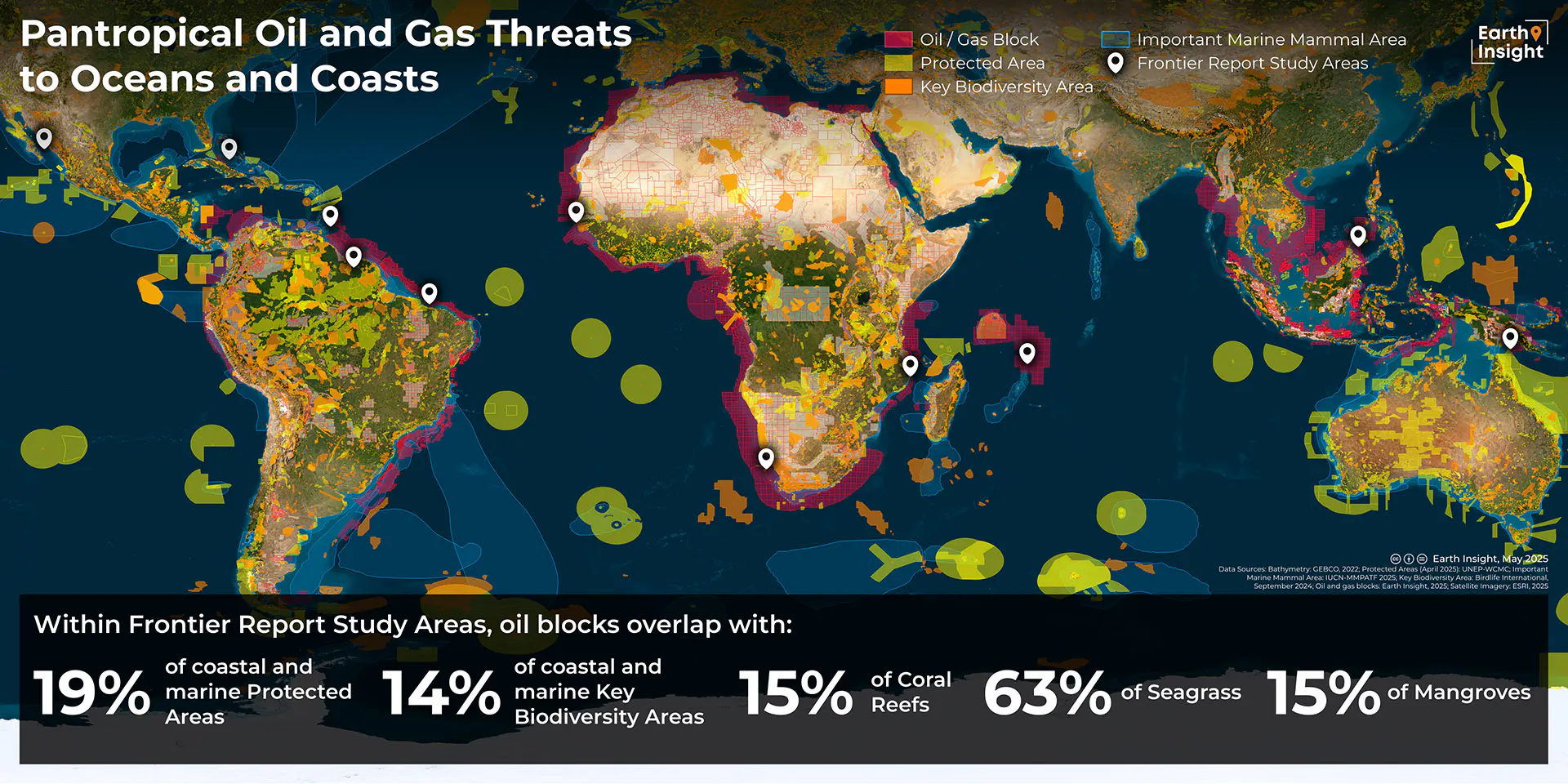
Fossil fuel expansion is also putting coastlines and highly biodiverse ocean regions at risk, from the Coral Triangle to the Sea of Cortez and beyond. Recent analyses illustrate the scale of the expansion threats to marine biodiversity hotspots:
- Ocean Frontiers At Risk found that oil and gas blocks overlap with 270 million hectares of frontier regions with no previous fossil fuel extraction, an area about the size of Argentina. These blocks threaten 19% of coastal and Marine Protected Areas in these regions and 13 Important Marine Mammal Areas. Twenty unique species are threatened by nearby offshore LNG terminal infrastructure.
- Coral Triangle At Risk found that in one of the most biodiverse marine ecosystems on the planet, which spans seven countries, oil and gas blocks overlap 16% of Marine Protected Areas, 24% of coral, 22% of seagrass meadows, and 37% of mangroves. Ongoing spills and slicks are a direct threat to communities.
Countries Leading the Way
In September 2025, Colombia, the host of the upcoming Conference on Transitioning Away from Fossil Fuels and one of the 18 countries leading the call for a Fossil Fuel Treaty, became the first country to declare a region-wide Fossil Free Zone, banning fossil fuels and large mining extraction across its entire Amazon region. The decision followed sustained pressure from Indigenous Peoples and civil society organisations and was reinforced by research showing that extracting untapped reserves beneath the Colombian Amazon would generate billions of dollars in “stranded assets” without a significant impact on national energy security. Recently, Colombia reaffirmed its commitment to Indigenous Peoples’ rights and critical ecosystems by reintroducing a similar prohibition in Sierra Nevada, the site of the upcoming fossil fuel conference. Other actions beyond Colombia include:
- The International Institute for Sustainable Development (IISD) recently identified 58 active restrictions on fossil fuel production across 25 countries and 27 subnational jurisdictions. Moreover, over 500 sub-national and local initiatives have declared themselves fossil-free zones, demonstrating broad grassroots momentum.
- Parliamentarians across four Amazon countries have simultaneously introduced legislation to make the Amazon ban region-wide.
- 11 Amazon Nations have joined a call for a Fossil Fuel Treaty, including the Waorani, who are fighting to leave the fossil fuels in the ground in the Yasuní National Park and showing the world why international cooperation is fundamental to phase out fossil fuels.
- Mexico established 100 million hectares of Safeguard Zones to restrict fossil fuel development in ecologically sensitive areas.
- Guatemala ended oil extraction in the Mayan Biosphere Reserve.
- Belize banned offshore oil and gas extraction entirely.
- Costa Rica established a moratorium on oil extraction through 2050.
- Canada banned future Arctic offshore exploration.
- The Philippines restricted the exploitation of energy resources in protected areas.
Indigenous Peoples and Civil Society Movement Momentum:
Indigenous Peoples and local communities, along with a wide range of civil society organizations and initiatives, demand that extractive activities stay out of vital biological and culturally diverse regions and for the defense of their territorial integrity and their right to self-determination, including Free Prior and Informed Consent (FPIC). For example:
- The Answer is Us: A global campaign created and led by Indigenous Peoples and local communities, one of its demands is an end to fossil fuel extraction and mining in their territories.
- Fossil Fuel Treaty: the proposed Treaty would be a key multilateral instrument for creating the first region-wide fossil-free zone in the Amazon, halting the expansion of oil and gas extraction, and developing comprehensive exit strategies, including comprehensive reparations for the affected territories.
- Amazon Free of Fossil Fuels: A coalition of Indigenous Peoples, local communities, and civil society to end fossil fuel expansion across the Amazon.
- Fossil Free Ocean Initiative: A civil society alliance to protect the ocean from fossil fuel exploration and exploitation.
- Protect the Verde Island Passage: A campaign to protect a marine corridor often called “the Amazon of the Oceans” in the Coral Triangle region.
- Our Land Without Oil: A campaign in the Democratic Republic of the Congo opposed to fossil fuel threats to the largest carbon sink in the world.
- Whales or Gas: A movement to stop LNG carriers from shipping through the Gulf of California, the largest concentration of marine mammals in the world.
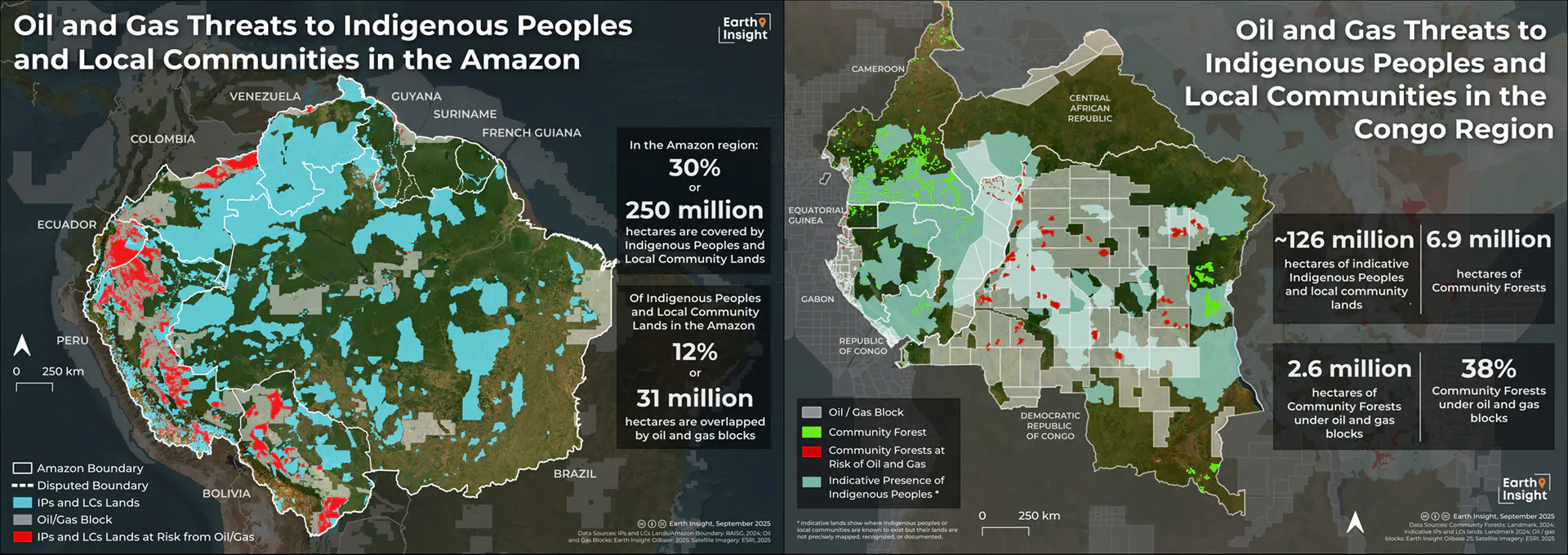
Oil and Gas Threats to Indigenous Peoples and Local Communities in the Amazon & Congo Regions.
Earth Insight
The Fossil Fuel Endgame: The Financial Sector
The world is entering the "fossil fuel endgame," a period of structurally declining demand as renewable energy scales rapidly. In 2025, wind and solar outpaced all new electricity demand, and more than a quarter of all vehicles sold globally were electric. In this context, frontier reserves (particularly those beneath forests) are increasingly likely to become stranded assets.
Developing untapped forest reserves requires massive public investment in infrastructure with long lead times. Roads built to access oil become vectors for illegal logging, mining, and agricultural encroachment and undermine ecosystem services on which economies depend, including water supply for rural and urban areas and agriculture, compounding long-term fiscal risk. Countries that lock themselves now into high-cost, high-risk frontier assets weaken their long-term economic resilience precisely when the global energy transition decreases fossil fuel demand.
Achieving this transition at the necessary speed and scale will not be possible without the private sector. Banks are among the key enablers of fossil fuel expansion in socially and environmentally sensitive areas. In the Amazon alone, for example, banks have directed more than $15 billion to oil and gas activities in the Amazon since the Paris Agreement was adopted in 2016.
Yet signs of change are emerging: Stand.Earth's Banks vs the Amazon report documents how sustained pressure from IndigenousPeoples leaders across Peru, Ecuador, and Brazil helped motivate eleven banks to restrict oil and gas financing in the Amazon Biome. While much more progress is needed, the trend reflects growing recognition that financing fossil fuel expansion in ecologically sensitive areas carries escalating reputational and legal risk — and that drilling in sensitive regions is a bet against the odds.
FFZs offer a concrete, alternative economic path. Protecting critical ecosystems generates jobs and revenue in protected area management, watershed services, sustainable tourism, and the socio-bioeconomy, while supporting local agriculture. For example, more than 33 million people are employed directly in the forest sector. The livelihoods of some 1.6 billion small forest farm producers depend on intact forest ecosystems. Already, over 500 sites and regions have declared themselves some form of fossil-free zone, and the list continues to grow.
Next Steps
2026 represents a rare moment of political alignment across three major international processes: the COP30 Presidency roadmap on Transitioning Away from Fossil Fuels, the COP30 Presidency roadmap on Halting and Reversing Deforestation, and the Global Biodiversity Framework review at CBD COP17 in Yerevan, where progress toward protecting 30% of the world's lands and waters by 2030 (30×30) will be assessed. FFZs sit at the intersection of all three by addressing a widely diagnosed negotiation gap: They bridge the Climate and Biodiversity agendas.
The question for governments is not how to replace the energy output of reserves that were never economically viable, but how to redirect the public investment and policy attention that would have gone toward extracting them. Countries that establish credible FFZs strengthen their eligibility for international climate and biodiversity finance mechanisms, including results-based payments for reducing deforestation like the Tropical Forest Forever Facility.
The upcoming First International Conference on Transitioning Away from Fossil Fuels will bring together 45 governments committed to concrete action. We hope this event will result in the inclusion of FFZs in their national transition plans, with shared guidance on how to identify eligible areas and implement them via existing policy tools (including protected area designations and the recognition of Indigenous Peoples Territories as highly effective strategies for the protection of key ecosystems)
Indigenous Peoples’ organizations in the Amazon region demand that exclusion zones in their territories be governed under their authority. Indigenous Peoples alone decide what takes place in their territories. Most of these territories in the Amazon share a cultural mandate of origin that “nothing should be taken out of the subsoil in Indigenous Peoples Territories,” which not only excludes fossil extraction in key ecological areas but also requires a biocultural approach based on their economic models and governance. The Global Alliance of Territorial Communities (GATC), which represents 36 million Indigenous Peoples and local communities across 24 countries who defend 958 million hectares of forests, has likewise called for the exclusion of all fossil fuel and mineral extraction from their territories in the Amazon, Mesoamerica, the Congo Basin, and Southeast Asia.