


New analysis by Earth Insight, released ahead of the summit, shows that across eleven frontier regions, 19% of Marine Protected Areas are already overlapped by active oil and gas blocks. The same expansion is encroaching on 179 million hectares of intact tropical moist forest.
Oceanographic Magazine
April 16, 2026
Words by Rob Hutchins
Photography by James Thornton & Oceana UK
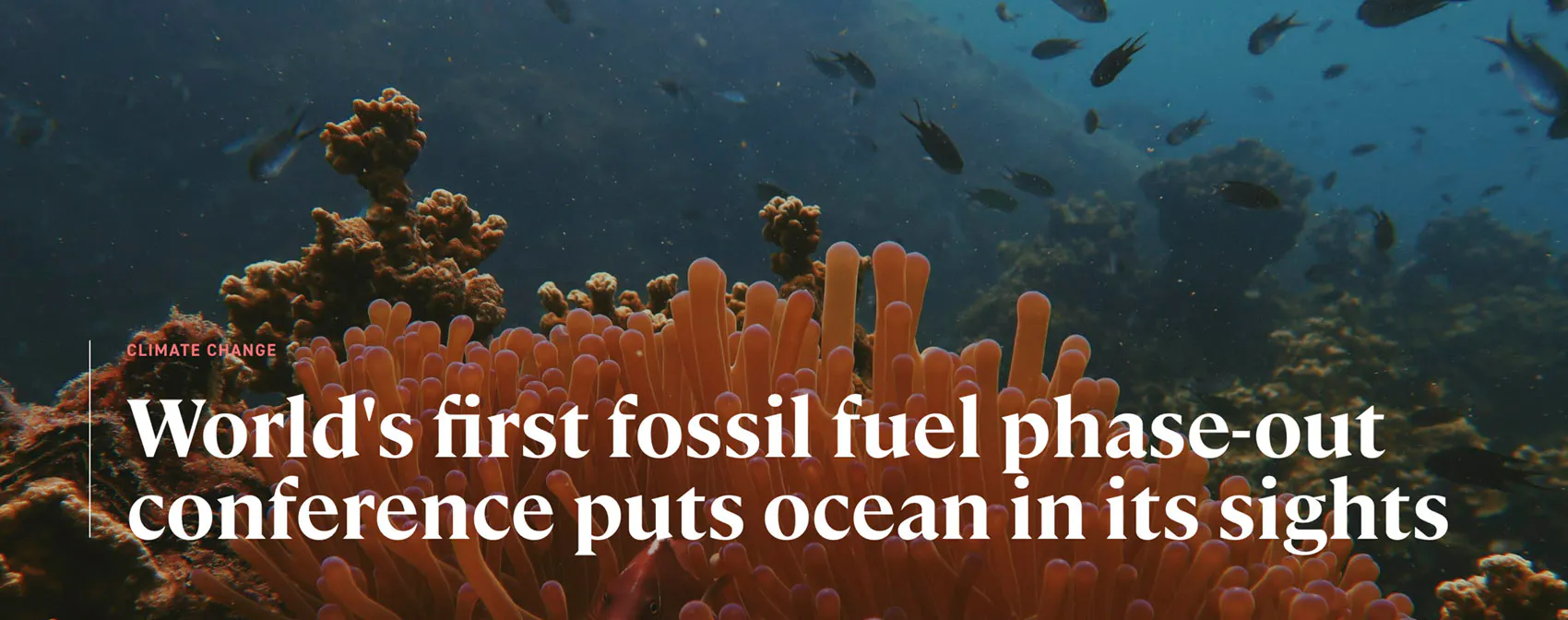
Photography by James Thornton & Oceana UK for Oceanographic Magazine
Policy makers from more than 45 countries will gather in Santa Marta, Colombia later this month for the First International Conference on Transitioning Away from Fossil Fuels, marking the first time governments have convened specifically to turn the global pledge to phase out fossil fuels into concrete policy.
While the conference has no direct precedent, the data being brought to the table makes clear why advocates say it presents a ‘moment that cannot be wasted.’
New analysis by Earth Insight, released ahead of the summit, shows that across 11 frontier regions, 19% of Marine Protected Areas are already overlapped by active oil and gas blocks. The same expansion is encroaching on 179 million hectares of intact tropical moist forest – roughly 21% of the world’s remaining high-integrity tropical forest across the Amazon, Congo Region, and Southeast Asia.
In the Amazon alone, 12% of Indigenous Peoples’ and Local Communities’ lands are overlapped by oil and gas blocks. In the Congo Basin, the figure for community forests reaches 38%.
The response being pushed by a coalition of Indigenous leaders, ocean advocates, and climate finance experts is a framework with a deliberately simple logic: Fossil-Free Zones – geographically defined areas where fossil fuel exploration, extraction, and related infrastructure are permanently off limits.
For the ocean science and conservation community, the marine data points to a fundamental contradiction at the heart of current policy: areas formally designated for protection are not, in practice, protected from fossil fuel development. Coral reefs, mangroves, and seagrass meadows – ecosystems that sequester carbon, sustain fisheries, and underpin coastal resilience – sit inside boundaries that oil and gas blocks routinely cross.
Bruna Campos, senior campaigner, Offshore Oil and Gas, Centre for International Environmental Law (CIEL), said: “Safeguarding our ocean is a cornerstone of climate action and a prerequisite for a successful fossil fuel phaseout. Transition plans must prioritise ending extraction in marine regions critical to ecological integrity, human rights, and climatic stability. By designating ‘fossil-free zones’ in vital habitats like coral reefs, mangroves, and seagrass meadows, we accelerate the global shift away from fossil fuels.”